
Trump Calls for End to Khamenei’s Rule as Iran Death Toll Mounts and U.S. Military Moves Intensify
 by Emmitt Barry, Worthy News Washington D.C. Bureau Chief
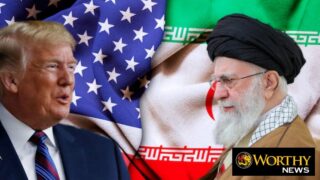
(Worthy News) – U.S. President Donald Trump on Saturday openly called for new leadership in Iran, directly challenging Supreme Leader Ali Khamenei amid the bloodiest unrest the Islamic Republic has faced in decades. Trump’s remarks mark his sharpest escalation yet toward Tehran as mass protests and a brutal crackdown have left thousands of Iranians dead and tens of thousands arrested.
“It’s time to look for new leadership in Iran,” Trump told Politico, targeting Khamenei personally after the 86-year-old leader blamed the U.S. president for the violence engulfing the country. Khamenei accused Trump of being a “criminal” responsible for the deaths of “several thousand” Iranians — an unusually candid admission of the scale of casualties by the regime.
The protests began on December 28 as demonstrations over economic hardship rapidly evolved into nationwide calls for an end to clerical rule. Human rights groups report that Iranian security forces have killed at least 3,090 protesters, with some estimates placing the death toll far higher. More than 24,000 people have been arrested, and prosecutors have warned that some detainees could face execution under charges of ‘moharebeh’ — “fighting God.”
In a televised religious address, Khamenei characterized the uprising as foreign-orchestrated “sedition,” accusing the United States and Israel of funding and arming protesters. He claimed demonstrators attacked mosques, infrastructure, banks, and medical facilities, and insisted the unrest had been “extinguished” following pro-government rallies. Iranian officials have also leaned on support from Russia at the United Nations, with Moscow echoing Tehran’s claims that Washington is fueling instability.
Trump responded forcefully, accusing Khamenei of destroying Iran through mass violence and repression. “Leadership is about respect, not fear and death,” the president said, calling the supreme leader “a sick man” who has turned Iran into “the worst place to live anywhere in the world.”
The confrontation follows days of mixed signals from Washington. Trump had briefly struck a conciliatory tone after Iran reportedly canceled more than 800 scheduled executions, praising the move on Truth Social. Yet he has also warned that continued killings or mass hangings would bring consequences, even as the regime presses forward with prosecutions.
As rhetoric escalates, the Pentagon is repositioning major assets to the Middle East. The aircraft carrier USS Abraham Lincoln and its strike group are en route to the region, accompanied by destroyers and additional fighter aircraft. Defense officials say the buildup is intended to provide Trump with a full range of military options should Iran escalate further.
Israeli leaders are closely monitoring developments. Prime Minister Benjamin Netanyahu convened senior defense officials to assess the situation, with Israeli sources indicating that a U.S. strike on Iran remains a possibility, though regional constraints and allied concerns continue to factor into Washington’s calculations.
Inside Iran, the crackdown has driven the country into near-total digital darkness, with internet connectivity reduced to a fraction of normal levels. Eyewitnesses describe security forces firing from rooftops, deploying drones, and deliberately targeting protesters’ faces. Medical professionals report widespread use of military-grade weapons, with hundreds blinded and thousands suffering gunshot and shrapnel wounds.
Analysts warn that the apparent calm following the repression may be deceptive. While fear dominates for now, experts say funerals and mourning rituals — especially 40-day memorials — could reignite unrest. “This level of suppression cannot be maintained indefinitely,” said one Israeli specialist on Iranian domestic affairs, noting that each memorial has the potential to draw crowds back into the streets.
What began as protests over inflation and economic collapse has become the greatest challenge to Iran’s clerical regime since the 1979 revolution. Trump’s blunt call for new leadership signals that Washington has abandoned any remaining pretense of accommodation with Khamenei’s government. Whether that rhetoric will translate into decisive action—and whether the Iranian people will again rise despite the bloodshed—now looms as a defining question for the region.

Worthy News reports from a biblical worldview with a commitment to accuracy, transparency, and editorial independence. Learn more about About Worthy News, our Editorial Standards, AI Use Policy, Ownership of Worthy News, News Tips and Corrections, and Worthy News Staff.
💡 Did you know? One of the best ways you can support Worthy News is by simply leaving a comment and sharing this article.
📢 Social media algorithms push content further when there’s more engagement — so every 👍 like, 💬 comment, and 🔄 share helps more people discover the truth. 🙌
Latest Worthy News
If you are interested in articles produced by Worthy News, please check out our FREE sydication service available to churches or online Christian ministries. To find out more, visit Worthy Plugins.