
Rubio Pledges Deeper U.S. Ties With Hungary And Slovakia Despite Ukraine Divisions
 by Stefan J. Bos, Worthy News Europe Bureau Chief reporting from Budapest, Hungary
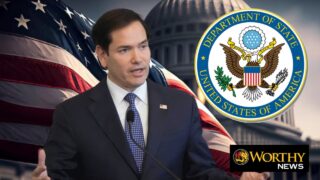
BRATISLAVA/BUDAPEST (Worthy News) – U.S. Secretary of State Marco Rubio has pledged to deepen cooperation with a group of four Central and Eastern European nations, including Hungary and Slovakia, despite concerns over their leaders’ perceived authoritarian style and refusal to provide military aid to war-torn Ukraine.
“The Visegrád Group, the V4, is something we are eager to engage with as a forum in which we can find areas where we can work together and achieve cooperation,” Rubio said of the alliance, which also includes Poland and the Czech Republic.
Rubio made the remarks in Bratislava, standing alongside Slovak Prime Minister Robert Fico, before traveling on to Budapest — a short flight between the neighboring capitals.
Under Fico, Slovakia halted state military assistance to Ukraine after Russia’s full-scale invasion in February 2022, arguing that the conflict requires negotiation rather than continued weapons deliveries.
Slovakia remains a member of the NATO military alliance and the European Union, even as its government has diverged from many Western allies on Ukraine policy.
RUBIO ACKNOWLEDGES FICO’S POSITION
“Your viewpoint … is one that’s formed by both your geography and by your history. And it’s a very important point of view to take into account in the broader context,” Rubio told Fico.
Hungarian Prime Minister Viktor Orbán, widely viewed as Moscow’s closest partner within the EU, shares Fico’s stance against sending weapons to Kyiv, adding to tensions within both NATO and the EU.
Yet Rubio emphasized Washington’s broader approach. “We expect every country in the world to act in their national interest. That is what countries are supposed to do. I don’t know why that is a strange consideration,” he said.
Rubio added that the United States is seeking to help bring the war to an end. “We are trying to facilitate an end to a very deadly, very bloody, very costly war,” he said.
He pointed to ongoing Russian strikes against Ukrainian energy infrastructure. “What’s happening in Kyiv right now is horrifying. People in the coldest part of the year going without electricity and energy. There’s just nothing positive about that,” Rubio added.
PEACE DIPLOMACY AND ELECTION SEASON IN HUNGARY
Rubio carried a similar message to Budapest, where Prime Minister Viktor Orbán’s government has floated the idea of hosting a peace summit involving Russian, U.S., and Ukrainian leaders.
The proposal comes as NATO member Hungary approaches parliamentary elections scheduled for April 12, with opinion polls suggesting Orbán’s long-ruling Fidesz party faces a significant challenge after 16 years in power.
Rubio was scheduled to meet Hungarian Foreign Minister Péter Szijjártó to discuss bilateral ties, nuclear energy cooperation, and prospects for ending the war in Ukraine.
He was also due to hold talks with Orbán focusing on peace efforts and broader U.S.–Hungarian relations.
Orbán, one of U.S. President Donald Trump’s closest allies in Europe, has received public support from Trump for his reelection bid and is often praised by American conservatives for his immigration policies and emphasis on national sovereignty.
ENERGY DEPENDENCE AND DEFENSE SPENDING DEBATE
Orbán also shares many of Fico’s views on Ukraine.
Unlike most EU countries that diversified energy supplies after Russia’s 2022 invasion, Hungary and Slovakia continue to import significant volumes of Russian oil and natural gas, a policy that has drawn criticism from Washington.
Separately, both countries currently meet NATO’s minimum defense spending target of 2 percent of gross domestic product, though Trump has called on allies to consider increasing that level to 5 percent.
Slovakia’s Fico has also diverged from Washington on Venezuela, sharply criticizing U.S. military action in early January that led to the capture of Venezuelan President Nicolás Maduro. He dismissed the U.S. operation as a violation of international law and part of a broader decline in the post-World War II global order, saying forced intervention undermines legal norms.
When asked about the issue during a joint news conference, Rubio shrugged off the difference of opinion, saying: “A lot of countries didn’t like what we did in Venezuela. That’s okay. That was in our national interest … So what? That doesn’t mean we’re not going to be friends.”
Rubio began his Central European tour at the Munich Security Conference, where his speech calling for renewed transatlantic cooperation drew mixed reactions from European leaders. German Chancellor Friedrich Merz cautioned that Europe must avoid internal divisions that could weaken collective security and underlined the need to uphold international law and shared burden-sharing within alliances.
Responding to criticism in Munich, Rubio said, “When our national interests are aligned, this is an extraordinary opportunity for cooperation and partnership,” before traveling on to Slovakia and Hungary.

Worthy News reports from a biblical worldview with a commitment to accuracy, transparency, and editorial independence. Learn more about About Worthy News, our Editorial Standards, AI Use Policy, Ownership of Worthy News, News Tips and Corrections, and Worthy News Staff.
💡 Did you know? One of the best ways you can support Worthy News is by simply leaving a comment and sharing this article.
📢 Social media algorithms push content further when there’s more engagement — so every 👍 like, 💬 comment, and 🔄 share helps more people discover the truth. 🙌
Latest Worthy News
If you are interested in articles produced by Worthy News, please check out our FREE sydication service available to churches or online Christian ministries. To find out more, visit Worthy Plugins.